

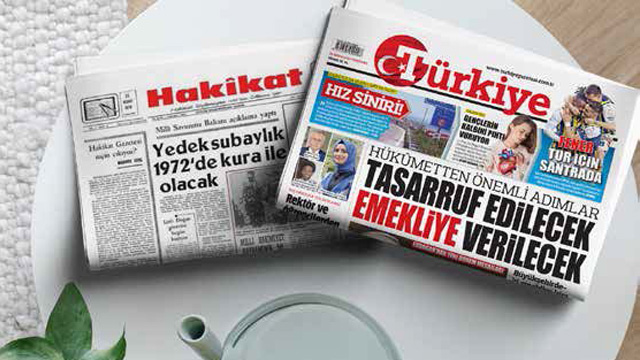
Turkey’s 55-Year Truth
Founded in 1970 by our late brother Enver Ören and a group of friends, Türkiye newspaper has been the strong voice of the oppressed in every arena throughout its 55-year publishing life, which has encompassed many successes. From Bosnia to Western Thrace, from Crimea to Kirkuk, from East Turkestan to Palestine, wherever there was a cry of the oppressed, Türkiye was there. Today, the newspaper continues the same path under the leadership of Ahmet Mücahid Ören.
“It is well known to those in the know that for a newspaper, having a sense of direction, not compromising for its ideals, being able to write what it believes to be right no matter the cost, and continuing its existence without resorting to frivolity, lightness, or obscenity is almost impossible. Especially if such a newspaper does not have huge capital behind it, does not receive advertising, and its staff consists of a handful of Anatolian children as pure as the soil of the homeland, and these children have been able to struggle to exist with their health, money, work, pens, and all their resources… It is not a newspaper, it is a flag…”
The late Enver Ören described the Türkiye newspaper, which celebrated its 14th anniversary in April 1984, with these lines. This flag, which Ören said was “woven with the threads of our faith, our lineage, our homeland, our past, our present, and our future,” eventually waved at the very peaks.
Because at its foundation was sincerity, that is, devotion. Its purpose was to serve the nation and Islam. This newspaper, which is the core of İhlas Holding, grew and developed with those principles and aims, and has peacefully completed 55 years without deviating from its course.
IN PURSUIT OF TRUTH
The Türkiye newspaper was founded in 1970 under the name “Hakikat” (Truth). In 1972, its name was changed to “Türkiye” (Turkey). It continued its existence as a small newspaper until 1980. In the period before September 12th, when brotherly blood flowed profusely in the streets, it took a stance on events as a conservative, nationalist newspaper. It became the voice of the silent majority. It always advocated for unity on the right. It stood by the leaders and ancestors that the left-wing press tried to tear apart. Of course, it was distanced from left-wing parties. However, when the cause of the homeland and the nation was at stake, it set aside these differences. While the 1974 Cyprus Peace Operation was underway, some hastily declared the then Prime Minister Bülent Ecevit the “Conqueror of Cyprus.” The Türkiye newspaper became a model of national stance in the press by writing, “Let’s win the victory, whoever the hero may be.”
IT TAUGHT CORRECT RELIGIOUS KNOWLEDGE
Türkiye competed with newspapers that sought to increase circulation through sensationalism and obscenity, but it stood apart from them. It did not stoop to sensationalism, immorality, or character assassination. Yes, it supported right-wing governments, but when necessary, it did not hesitate to take a stand against them and expose their actions that were against the nation’s interests. For example, in 1986, together with 19 scientists working in the USA, it published a warning statement to the government, a statement of which there is no precedent for such a constructive declaration. It did not compromise on the Sunni line and became a steadfast fortress of the cause. It paid a heavy price for this during the February 28th period. There is no other newspaper that has published religious pages regularly every day since its first day of publication.
A NEWSPAPER THAT PROVIDES PEACE
After 1980, Türkiye newspaper, together with the late Turgut Özal, drew a vision for a strengthened and outward-looking Turkey with its publications. It demonstrated that positive news is also valuable. It established itself in the eyes of our nation as “a family newspaper.” It adopted the slogan “The newspaper that brings peace.” This wasn’t just empty rhetoric; it was the voice of a long-suffering nation, weary and overwhelmed by years of coups, conflicts, chaos, and economic hardship. The leadership of its owner, who acted as an older brother to his employees, the dedication of those under his command, and the sincerity in its publications resonated with readers. Türkiye newspaper grew with its loyal readers, who embraced it and left it as a legacy to their children, and reached unimaginable heights. Its circulation, which was around 20,000 in the early 1980s, expanded exponentially, exceeding 1,400,000 in 1990. This sales record, written in golden letters in the history of the press, remains unbroken.
THE TURKISH-ISLAMIC CAUSE
The Türkiye newspaper became the resounding voice of the Turkish and Islamic cause with its news coverage. Photographs from Hama, where Hafez al-Assad committed massacres in 1982, were published in Türkiye Newspaper for the first time in the Turkish press. In the mid-1980s, Türkiye brought to light the persecution of ethnic Turks in Bulgaria and followed the case closely. The Türkiye newspaper was the first to enter the Belene Camp, where ethnic Turks were held captive and which was almost impossible to reach. Aysel, who became a symbol of Bulgarian oppression at that time, was brought to our country through the initiative of Türkiye newspaper reporters Kâmuran Abacıoğlu and Servet Kabaklı. A condemnation statement against Bulgaria was published. After the collapse of the Soviet Union, the late Kemal Çapraz was the first Türkiye newspaper reporter to enter Crimea, which had been tormented by communism for years. Enver Ören gave all the broadcasting rights of the TGRT film “Kurdoğlu” to the Crimean Tatar National Assembly. The first newspaper to enter Kirkuk after the Gulf War was Türkiye Newspaper.
THE STANDARD BEARER OF BOSNIA
While Serbs were brutally massacring Muslims in Bosnia, a legacy of their ancestors, Türkiye newspaper spearheaded the awakening movement in Turkey. In 1992, for the first time in the Turkish press, Foreign News Editor Murat Yeşil and reporter Ercan Seki entered the fire circle and exposed the genocide in Bosnia. In 1992, the Turkish World Writers’ Congress was held in Ankara. Intellectuals called for “Let’s not remain spectators to the massacre in Bosnia.” An open letter was written to President Turgut Özal. The person who delivered the letter to Çankaya was none other than Enver Ören. Subsequently, at Özal’s call, an Islamic summit was held in Dakar, bringing the issue to the world agenda. It was again Türkiye newspaper that obtained special statements from leading European politicians regarding Bosnia and published them on its front page, trying to create public opinion. The Turkish newspaper Türkiye opened an office in Sarajevo under those circumstances, even though President Süleyman Demirel was turned away from its doors twice.
OH! EAST TURKISTAN
Don’t be fooled by those who are now writing about the East Turkistan cause. While nobody in Turkey even knew where East Turkistan was, the Türkiye newspaper was sending reporters and preparing series of articles from the ancestral lands. So much so that the legendary leader of East Turkistan, the late İsa Yusuf Alptekin, had bequeathed, “I entrust the East Turkistan cause to my friend Dr. Enver Ören.” It was also Türkiye newspaper that introduced Mustafa Cemil Kırımoğlu, the leader of the Crimean Turks, to Turkey. The legendary leader of Western Thrace, the late Sadık Ahmet, came to the newspaper and personally thanked Enver Ören, embracing him, for his support.
FIRST STATEMENTS TO TÜRKİYE
As the Soviet Union collapsed and the Turkic Republics declared their independence one by one, the Türkiye newspaper made their voices heard. Turkish reporters dispersed to various Turkish provinces to share their impressions. The Türkiye newspaper launched a project called “Turkish Brotherhood Volunteers” to empower brotherly countries and strengthen ties among Turkish scholars. The then-Presidents of Azerbaijan (Ebulfaz Elcibey), Kazakhstan (Nursultan Nazarbayev), Uzbekistan (Islam Karimov), Nakhichevan (Haydar Aliyev), and Afghanistan (Sibgatullah Mucaddidi) gave their first statements to Türkiye newspaper. Father Aliyev, visiting the newspaper, expressed his gratitude to Enver Ören, saying, “I thank Türkiye newspaper for its services to Turkishness and the Turkic world.” The issue of Turkic states adopting a common alphabet, debated today, was one of Türkiye newspaper’s topics in 1992.
Years later, while Armenians were shedding blood in Karabakh, a Turkish territory that had regained its freedom, Türkiye reporter Murat Arvas reported the drama from the front lines. Osman Sağırlı was the first to enter Karabakh after many years during the ceasefire period. Sağırlı also revealed to the world that organ trafficking was taking place in Somalia under UN supervision. He went and documented the genocide committed by Myanmar against the Rohingya (Arakan) Muslims and conveyed it to the Turkish public. The Zionist occupation of Jerusalem and the Saudi machinations in the holy lands were featured as exclusive headlines. Everyone knows about Enver Ören’s services to the members of the Ottoman dynasty.
In short, Türkiye is truly more than just a newspaper.